Applause roared from inside of the Colden Auditorium at Queens College during Richmond Hill High School graduation 2017.
Jay Sobhraj, Executive Vice-President of Zara Realty, just announced the names of two RHHS graduates who will be receiving a scholarship to study computer science at the college of their dreams.
Estrella Perez will be studying at the Borough of Manhattan Community College and Malik Assad will be studying at the New York Institute of Technology.
"We are so grateful to Zara for this opportunity," said Perez, who is passionate about computer science. "I will not let you down Mr. Sobhraj," Assad proclaimed, as photos were being taken of the two.
The relationship between Richmond Hill High School and Zara Realty began last year when Zara Realty donated a $125,000 computer lab to the school. The computer lab has been used by a plethora of students for everything from curriculum to extracurriculars.
“This is a model for building real community between the school and the private community,” Principal Neil Ganesh said. “We have future leaders in our program and we’re really excited about this new resource for us.”
Recently, Sobhraj and information technology specialist Naresh Singh returned to the school recently to see how the “seed turned into a plant with burgeoning fruit.” Not only have students been able to focus on their passion of computer science, but there has been a trickle down effect into the school’s robotics program.
They found that the computer lab helped Perez, Assad, and the rest of the robotics team focus on enhancing their computer science knowledge, engineering skills, and form a serious direction for their robotics team, Qubit. In just one year, the team has been able to achieve incredible success which includes building their own robot.
Sobhraj and Singh were so impressed with the focus and determination of the these RHHS students, that they decided to announce the plan to award two computer science college scholarships right then and there.
“I really want to give back,” said Jay Sobhraj. “Never forget where you come from and always give back to the community... that's what Zara is focused on.”
Richmond Hill High School offers several pathways, which include computer science and IT, art, criminology and forensics, business and engineering. As a supporter of computer science and IT, Zara Realty plans to grant one or two students with this opportunity each year.
"We are grateful to Mr. Sobhraj and Zara Realty for being an active community partner with their vision set on making a long term change," said RHHS Assistant Principal, Paul Wilbur.
Zara Luxury Homes, the innovative real estate holding company, provides quality homes in both Queens and Long Island. They have been serving the rental community for 36 years. Visit theirwebsite or call them at 718-291-3331 to inquire about their rental properties in Jamaica, Queens and Long Island.
When Kevin Wolfe began the task of redesigning the dining area at the Douglaston Club, he knew the job required a balancing act of sorts.
The club was built in 1819 by Wynant Van Zandt, a merchant and alderman who had purchased the entire peninsula estate and established a church for the community. The site was later bought by George Douglas in 1862. The Douglas family is the namesake for the neighborhood.
After briefly serving as a hotel in the early 20th century, the mansion became the Douglaston Club in 1921.
Wolfe, a local architect and member of the club, knew he had to revive the historic qualities of the building, but tailor it for a different function.
“The building that was a private house, suddenly you’re asking it to perform as an institution for a club,” he said. “Very different uses.”
The dining area was last renovated in the 80’s, Wolfe said. But in the last decade or so, the rooms fell out of use. No one wanted to have dinner there.
“The manager no longer seated people here,” Wolfe said. “It would just be for overflow when he had no other space.”
When Wolfe’s firm began the remodeling work pro bono, he found that the rooms were “completely disassembled.” The ceiling was two feet lower. A large, loud air conditioner that members dubbed “Big Bertha” was a hindrance. Some of the moldings were badly damaged.
The black fireplace, made of special marble from Italy, was almost falling off the wall. Wolfe described it as “hanging by a thread.”
The mirror atop the fireplace, though made with red velvet, somehow looked green due to the dirt and grime that had accumulated over the years.
To restore the rooms to their original glory, Wolfe collaborated with club members and specialists. A restoration specialist and his crew spent two weeks taking the fireplace apart. They laid it on the floor, numbered it, cleaned and polished it and put it back together.
The mirror was taken to another specialist, who used Q-Tips to remove the paint. She discovered that 95 percent of the gilding was still intact, and once the piece was restored, it sparkled brightly.
Another club member who owned a drapery business, that did the drapes for the Obama White House, donated the material to the club.
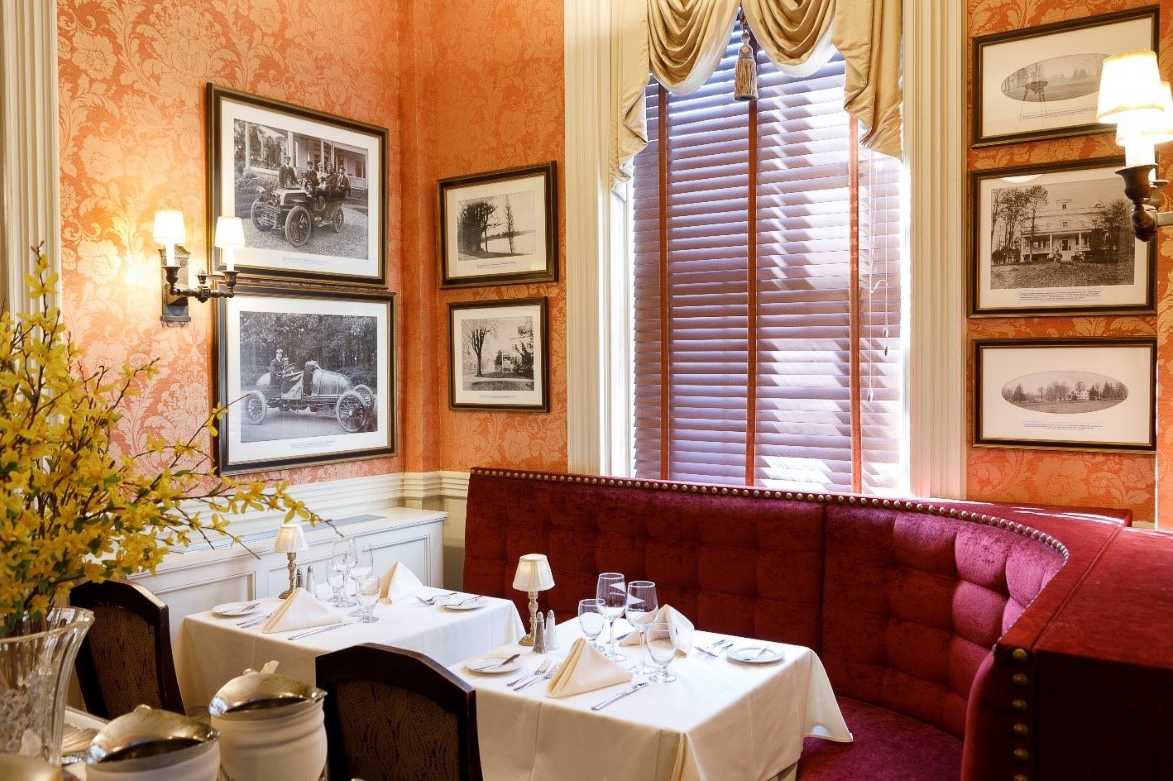
Wolfe and his firm partner, Pamela Broderick, worked out the color scheme, wallpaper and fabrics for the redesigned dining area. They chose heavy duty, industrial-strength velvets that looked elegant, but could still withstand the typical blemishes of a restaurant-style operation.
“You can throw pizza on this and it’ll survive,” Wolfe said. “You can spill food on it, clean it up and it really springs back.”
To compliment the mood and theme, Broderick found two big pieces of artwork that display both an aerial view and plan view of Rome. She bought them from an antique store in Huntington that had trouble selling them because they were so big, but they were the right fit for the club.
“Part of the theme was the people who owned this house were very sophisticated world travelers,” Wolfe said.
The walls are also adorned with photos from a historical group called Preservation Long Island. The pictures were all taken between 1900 and 1910, which is the era that Wolfe wanted to take diners back to.
The rooms also featured light fixtures, found in an antique store in Newport, and sconces from a shop in Roslyn.
“We wanted to evoke a post-electricity period,” Wolfe said. “So we hunted all over to pull it together to look like it had always been here.”
The changes were greeted with great success, the architect said. Club members now gravitate toward the space, especially if they prefer a quiet place to dine and have a conversation.
They’ve created a warm, inviting and intentionally formal dining area, Wolfe said, where a club member can invite their friends for a meal.
For a more informal setting, the club has other rooms, including the grill room, that are more suited for social events.
“You want to give people all kinds of choices of where to go and enhance that,” Wolfe said.
With a building so rare, and with so much history, Wolfe said he embarked on this project to put the site back in its place as an important part of Queens and New York City history.
He knows that 20 years from now, the furnishings, the pictures on the walls and other aspects of the room will change.
“But that’s the way it should be,” he said. “Just keeps continuing.”
Wolfe’s work on the Douglaston Club was honored by the Queens Chamber of Commerce’s with one of it’s annual Buildings Awards, as was Wolfe’s work on the Chan Lee Residence, which is also located along the Douglaston waterfront.
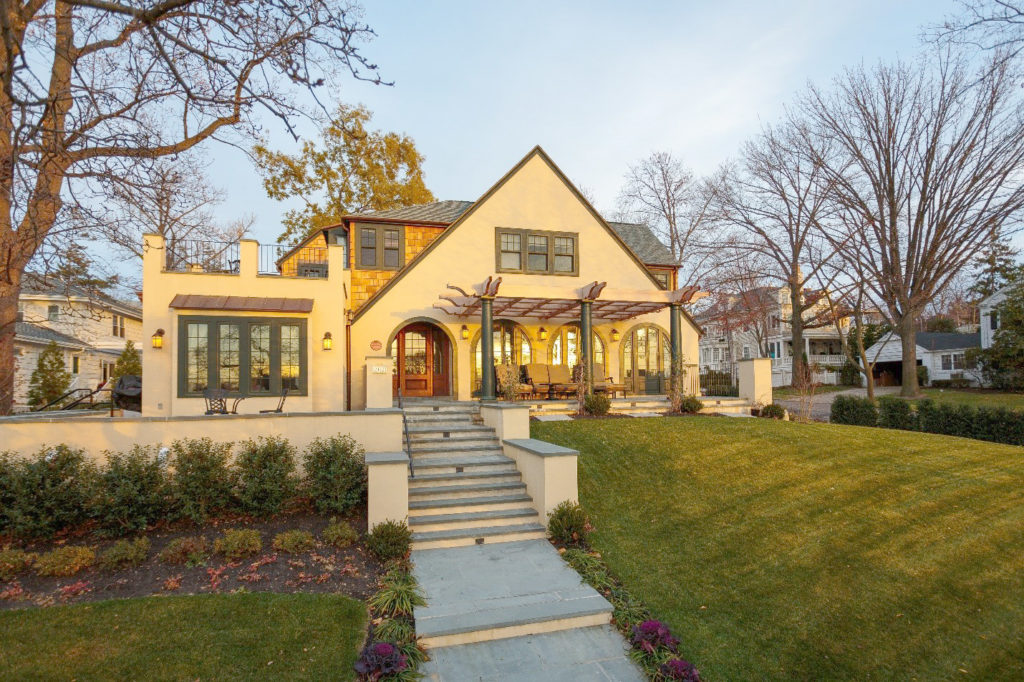
Built in 1919, the house has an interesting social history, he said. Three famous artists have called that house home. One of the first was Erwin Piscatore, a German theater director and producer who lived there in the 19th century.
The most recent owner was Claudio Araujo, a world-famous pianist who came up as a child prodigy. He lived there until around 1990, when he died.
Perhaps the most famous was painter and artist George Grosz, a German refugee who had fled Hitler’s Nazi regime.
“He did these amazing caricatures of the bourgeoisie that were very disturbing to people in the Weimar Republic,” Wolfe said. “They wanted to kill him, so he fled in the late 30s.”
Despite being home to three artists, the home itself was not kept in good condition. Originally a stucco house, which is one of the lowest maintenance materials, the residence had been altered so many times it ended up in “terrible shape.”
Araujo, the pianist, built a soundproof room facing the water, but it was poorly done. Wolfe said it had mold in it, and its position blocked every other room in the house from seeing the bay.
When Wolfe’s team had begun excavating, they found that that the foundation was unstable, and had to be resupported. The home had to be stripped down “to the studs,” he said.
They replaced an addition and pushed it further back. The restored the front of the house and built a pergola. Wolfe also reoriented the house back toward the bay.
“It’s a complete reconstruction and reimagination of the house,” he said. “All the rooms inside have been reimagined for a 21st century family.”